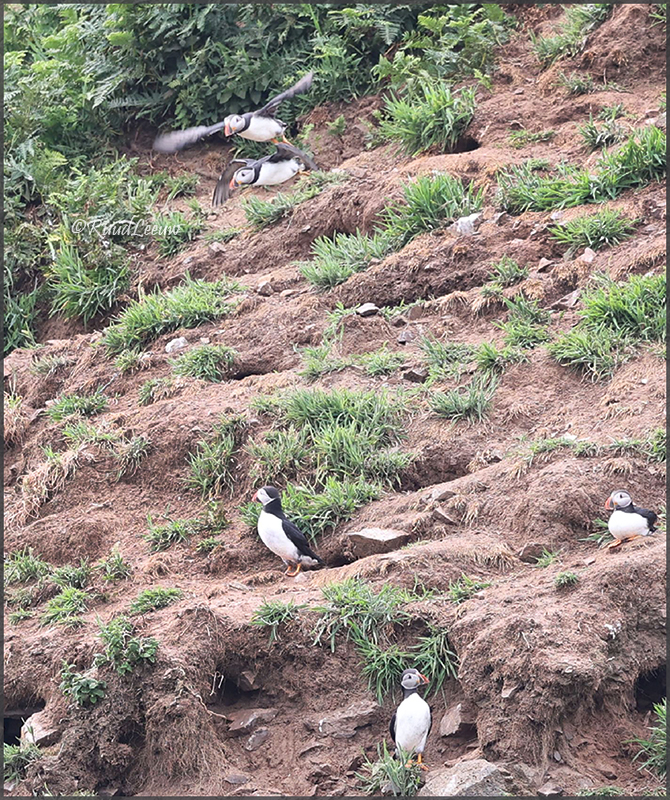
'Between April and July, Skomer is well known for its puffins, but there is so much more to this National Nature
Reserve - including Manx shearwaters, dolphins, seals, razorbills, and so much more!'

I'd read about Skoholm and smaller Skokholm in a book about Britain years ago. A visit was postponed
multiple times for the Covid-19 pandemic and subsequent developments in travel restrictions. But the day had come!
 The bird I particularly came for were the Puffins, they come ashore to breed in the months of June & July. The bird I particularly came for were the Puffins, they come ashore to breed in the months of June & July.
The Puffin's design is a trade off between flight and diving underwater. Like other Auks their bones are heavier
than most birds, enabling them to dive to depths of 60 metres.

I was told that the much needed depth of c.50m was not far from the island, so the Puffins do not need to fly far.
Skomer's Puffin (Fratercula artica; NL: Papegaaiduiker) population is the largest in southern Britain with over
25.000 birds
returning to breed
annually between late March and the end of July.

Guillemots (NL: Zeekoeten) is the common name for several species of seabird in the Alcidae or auk family (part of the order Charadriiformes).
In British use, the term comprises two genera: Uria and Cepphus.
In North America the Uria species are called murres and only the Cepphus species are called "guillemots". This word of French origin derives from a form of the name William, cf. French: Guillaume.
The two living species of Uria, together with the razorbill, dovekie, and the extinct great auk, make up the tribe Alcini.
They have distinctly white bellies, thicker and longer bills than Cepphus, and form very dense colonies on cliffs during the reproductive season.
Guillemot eggs are large (around 11% of female weight), pyriform in shape, and colourful, making them attractive targets for egg collectors. [- Wikipedia] |
The Wildlife Trust of South and West Wales manages 90
nature reserves, including Skomer.
www.welshwildlife.org
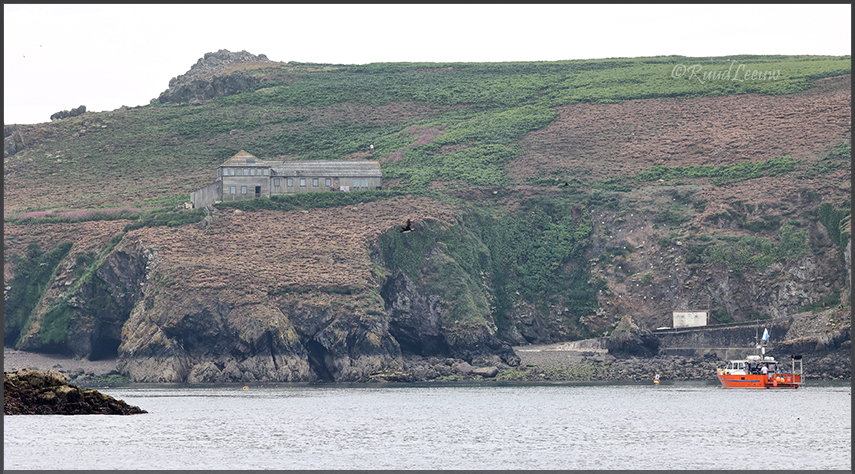
The Warden's House and research accommodation; it boasts solar and wind-powered systems these days,
providing hot water and electricity. It replaced the 1959 building, built with help of the RAF and lasted 46 years.
Skomer is a National Nature Reserve, a Site of Special Scientific Interest and a world-renowned bird paradise.
This sweet and 'petite' natural history book by Skomer resident Jane Matthews illustrates the landscape, seasons, flora, and fauna in over 150 photographs.
Skomer Island lies less than a mile off shore from the Marloes Peninsula in Pembrokeshire, yet it is this short span of water that sets the island a world apart from its neighbors. Free from all land-based predators (rats, mice, mink & stoat) Skomer has evolved as its own bustling ecosystem in a unique and spectacular landscape.
The island and its flora and fauna is closely monitored by specialists and volunteers.
Next time I am in the area I will book a trip ashore and take my chances on the weather. This time I was lucky and why wouldn't I be the next time! |

A Razorbill (Alca torda; NL: Alk), they too nest on Skomer (in internationally important numbers).
The razorbill, razor-billed auk, or lesser auk, is a North Atlantic colonial seabird and the only extant member of the genus Alca of the family Alcidae, the auks.
It is the closest living relative of the extinct great auk (Pinguinus impennis).
Razorbills are primarily black with a white underside. The male and female are identical in plumage; however, males are generally larger than females.
This agile bird, which is capable of both flight and diving, has a predominantly aquatic lifestyle and only comes to land in order to breed.
It is monogamous, choosing one partner for life. Females lay one egg per year.
Razorbills nest along coastal cliffs in enclosed or slightly exposed crevices. The parents spend equal amounts of time incubating, and once the chick has hatched, they take turns foraging for their young. [Wikipedia] |

The Atlantic puffin (Fratercula arctica), also known as the common puffin, is a species of seabird in the Auk family. It is the only puffin native to the Atlantic Ocean; two related species, the tufted puffin and the horned puffin are found in the northeastern Pacific.
The Atlantic puffin breeds in Russia, Iceland, Ireland, Norway, Greenland, Newfoundland and Labrador, Nova Scotia, and the Faroe Islands, and as far south as Maine in the west and France in the east.
It is most commonly found in the Westman Islands, Iceland.
Although it has a large population and a wide range, the species has declined rapidly, at least in parts of its range, resulting in it being rated as vulnerable by the IUCN.
On land, it has the typical upright stance of an auk. At sea, it swims on the surface and feeds on small fish and crabs, which it catches by diving underwater, using its wings for propulsion. [Wikipedia] |


This puffin has a black crown and back, pale grey cheek patches, and a white body and underparts.
Its broad, boldly marked red-and-black beak and orange legs contrast with its plumage. It moults while at sea in the winter, and some of the brightly coloured facial characteristics are lost, with colour returning during the spring.
The external appearances of the adult male and female are identical, though the male is usually slightly larger.
The juvenile has similar plumage, but its cheek patches are dark grey. The juvenile does not have brightly coloured head ornamentation, its bill is narrower and is dark grey with a yellowish-brown tip, and its legs and feet are also dark.
Puffins from northern populations are typically larger than in the south and these populations are generally considered a different subspecies. [ Wikipedia] |

On their small wings they fly with impressive speed!
|