
Via (aviation) museums at Hermeskeil, Speyer and Sinsheim, enjoying 2 nights in rural Germany, we proceeded to our main destination in Austria: Vienna!

The huge Stephansdom ("Stephen's Cathedral") sits opposite a very modern building in central Vienna. We walked the area around it. This cathedral is 107m long and 34m wide. It has 4 towers: the highest is the south tower at 136m, the north tower is not finished and is only 68m. On the left and on the right from the main entrance are the two "heath towers", which are about 65m. Like many buildings it was surrounded by scaffolding. |
 History meets the present. The people in costumes seemed to be guides and we did not bother with them; but they did add a nice touch to this area.
|
 The interior of the cathedral is truly impressive!
St. Stephen's Cathedral is situated in the city center and for centuries now it has been the heart of Vienna. It is one of the most famous Viennese sights and was built in 1147. |
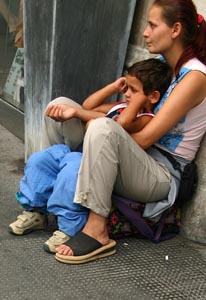
I saw many people from Eastern Europe sitting on the streets, hoping for a handout. That is what you see in a country which is on the crossroads between East (poor) and West (wealthy) ! |
 While we, in Holland, have discussions about the scarves muslim women wear, the burqa is seldomly seen; but here I saw several.
I don't feel comfortable with people hiding their faces. |
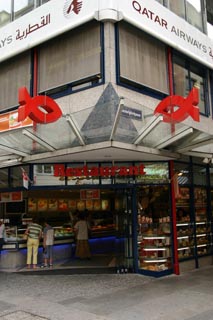 The "Jesus fish" symbol, while overhead sits the titles of an airline from the Middle East...
The symbol has to do of course with the shop it advertises for, but still: a remarkable coincidence! |
 Fun shopping in the boutiques of the Kaerntnerstrasse.
We did not find any good bookshops here, most shops seemed to deal with exclusive clothing; and here too: building and restorations going on everywhere! |
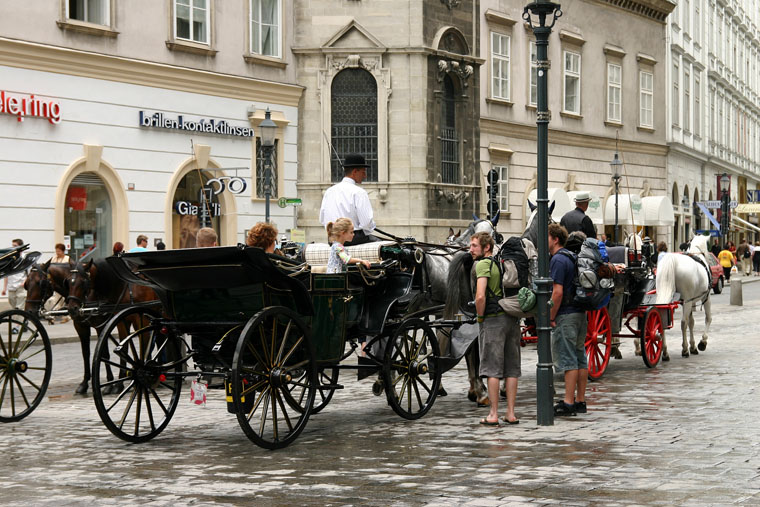 There are different ways to see this city: I don't think the backpackers will opt for the horse drawn carriages. |
 I like it when people take their photography seriously! |
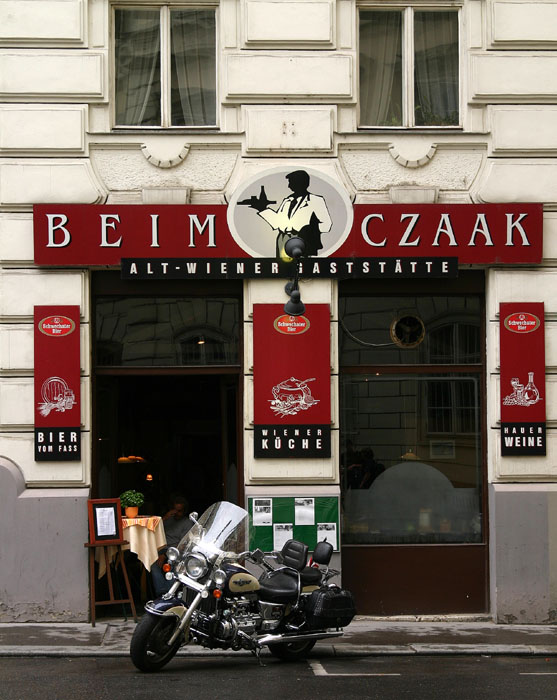
 Motorcycles come here in all kinds; the one on the right is carved from wood. |
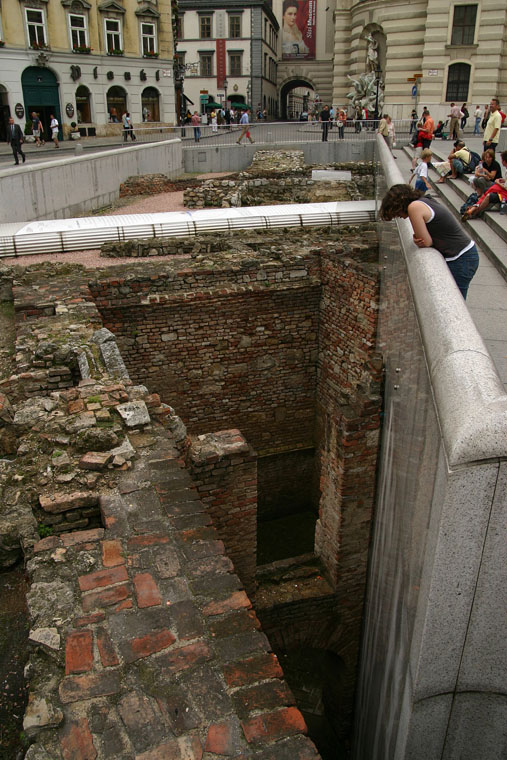 Plenty of history above ground, but even more below ground..
The ruins preserved here reveal a view into the history of Michaelerplatz from the time of the Romans until the late 19th Century. They were uncovered between 1990 and 1991 in archaeological excavations carried out by the Stadtarchäologie Wien. Documentation included the structural remains of the settlement outside the Roman legionary fortress, the Renaissance-period walls enclosing the "Paradeisgartel" belonging to the Hofburg and also the foundation walls of the Hofburg Theatre built in 1776 as well as rented houses of the early 18th Century. These were demolished in 1889. |

 Baroque... |
 Resting our feet at a small but pleasant Australian bar, the symmetrie in this picture struck me.
|

Quite an illegal game and after 3 or 4 victims, they quickly moved on. I don't know what the English name is, but in Holland we call it "balletje, balletje"... |

We searched for the Virgin Megastore on the Mariahilferstrasse, but they no longer existed. Perseverance om my son's part brought us to this shop, in a side street of the Mariahilferstrasse: the Fischer Music shop; it stocked an excellent selection against convenient prices. |

A good place to rest the feet again: Starbucks! The backpack is my new camera bag and my family started to make fun of me: nicknaming me a turtle... |
The Hundertwasser House... a pity not more architects followed his example! 
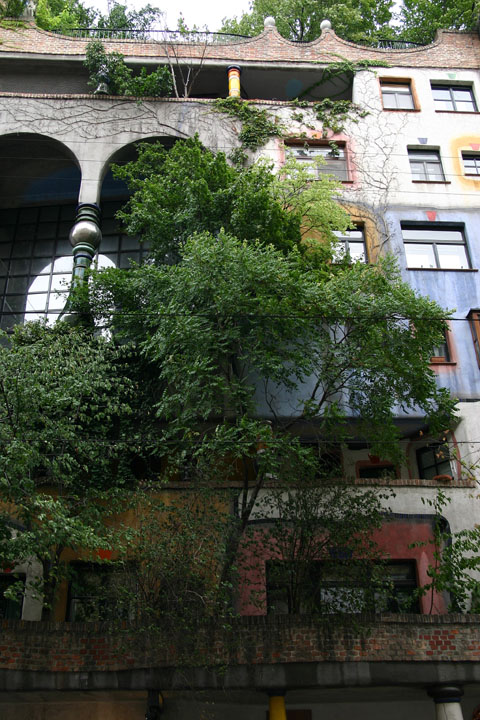 In 1948 Friendensreich Hundertwasser studied at the Vienna Academy of Fine Arts for 4 months. A year later he changed his name to Friedensreich Hundertwasser, which means "full-of-peace hundred-water". From 1949 to 1952 he undertook many journeys to North Africa and Paris, where he started to deal with the paintings of Gustav Klimt, Paul Klee and others. In 1962 Hundertwasser had his international break through at the Biennale in Venice. Around this time he also made ideological statements, with his famous nudist speeches and his call for peace, ecology and new forms of architecture. Not unlike the artists of the Session Movement, he saw art as a decoration. Hundertwasser got even more famous as an architect. From 1986 to 1991 he planned and realised different buildings, like the Hundertwasser Haus and the front of the waste combustion Spittelau. |

I used to do this too: taking pictures of my girlfriend against all possible backgrounds! |
We visited a rather unique museum: Tatort Vienna!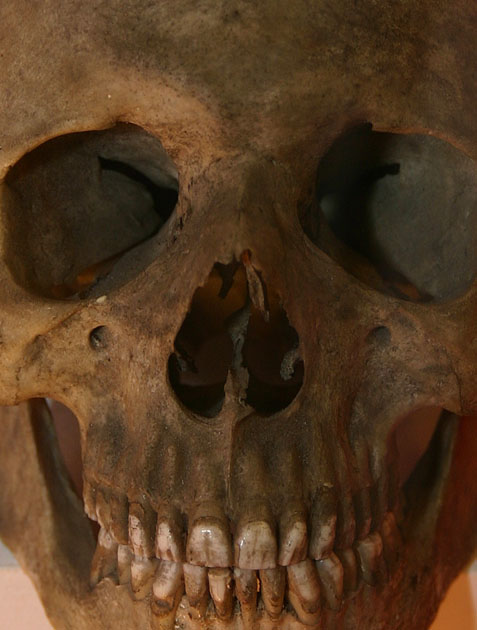 Visitors of the Crime Museum should have good nerves: here, the most sensational Austrian crimes of the past are documented, as well as the different methods of capital punishment...
The museum is housed in the so-called Seifensiederhaus (literally: soap-boiler house), one of the oldest buildings in Leopoldstadt (Vienna's second district). It was rebuilt in 1685, shortly after the Turkish Siege. Reports of murders from the Middle Ages to the present day are prominently presented: from the illustrated slates of street ballad singers to the leaflets containing biographies of famous criminals to the newspaper reports of today. Political criminality in Austria, including the assassination attempts on the Imperial and the development of the police and its methods is documented in the museum. |
 Among many photos and stories detailing murder, there is this currency fraud. I was fascinated by this as "Gulden" was also the Dutch currency before the Euro took over...
 Research brought me to this: At the end of the 1870s nearly all European countries and the U.S.A. had adopted a gold standard. Austria remained on a silver standard, which entailed steadily growing losses. Finally, Austria adopted a gold standard with the introduction of the krone in 1892, satisfying an urgent need for monetary reform. The Austrian gulden was valued at 2 kronen, with 1 krone subdivided into 100 hellers. Banknotes entitled “Österreichische Währung” (Austrian currency) remained legal tender until 1900, when the krone was declared sole legal tender. Source: Gulden and krone currency |
 There are many baroque buildings in this city, but I did not connect, wasn't impressed.
For some reason I liked Madrid much better, Vienna seemed distant, exclusive.
The history of this country is basically the history of one family. The beginnings of Austria, from the 9th century, find the Germanic peoples more or less united in a loose confederation under the overlordship of the Holy Roman Empire. Austria in those days, was just a small province. In the region where the Danube descends from the hills to enter the Great Hungarian Plain the empire reached its eastern boundary. Here on the Danube where Melk, Enns and St. Pölten now lie, the emperors established a heavily fortified frontier called the Eastern Marches. In Old German this is Ostarichi, which becomes Österreich or Austria. |
 Burial room: The KAISERGRUFT...
Kaisergruft is the Pantheon of Habsbourg; 138 members of majestic family rest there; Kaiserin Maria-Theresia, Francis-Joseph, Sissi and the Rodolphe archduke are joined together in Kaisergruft.
|
 In the basement of the Kapuzinerkirche (Capuchin Church, on the southwest corner of the Neuer Markt), is one of the more intriguing sights in Vienna: the Kaisergruft (Imperial Burial Vault). The crypts contain the partial remains of 138 Habsburgs (the hearts are in the Augustinerkirche and the entrails in St. Stephen's) plus one non-Habsburg governess ("She was always with us in life," said Maria Theresa, "why not in death?"). Their coffins lie in rows, ranging from the simplest coffins to the huge and distinguished tomb of Maria Theresa and her husband: designed while the couple still lived(!); their monument shows the empress in bed with her husband -- awaking to the Last Judgment as if it were just another weekday morning... see below.
travel2.nytimes.com/top/features/travel/destinations/europe/austria/vienna/ |
 Maria Theresia is a great figure in Austrian history. She was Empress from 1740-80, a highly successful and popular monarch. This was in spite of almost constant war. First, other European nations declared war on Austria on the spurious grounds that a woman had no right to the imperial throne. Then after eventual victory she found herself repelling the new might of the Prussians who were flexing their muscles against Austrian possessions. In spite of these external troubles, Maria Theresia proved herself a great reformer at home, bringing Austrian internal policy into the modern world, establishing a system of public education, a civil service, modernizing the army and streamlining the economy. She is one of the great women of European history (as well as being the mother of Marie Antoinette). Frederick the Great of Prussia famously said: "When the Hapsburgs finally get a great man, it's a woman."
Source: Country Profile: Austria |
|
The Kunsthistorisches Museum Vienna It has an excellent weapons and armoury collection. This collection is regarded to be the best-documented courtly armoury in the Western world. There are objects representing almost all the western European sovereigns and princes from the 15th to the early 20th centuries.  The suits of armour on display were custom-made by the most renowned armourers, while the sometimes magnificent etching is often based on the designs of famous artists such as Dürer and Holbein.
 I enjoyed this visit to the Imperial Armoury (Hofjagd und Rüstkammer).
Items on display date as far back as to the 15th Century. The collection of suits of armour is truly splendid and imagine: many of these belonged to the most powerful kings and nobles in Europe! The Kunsthistorisches Museum Vienna |
 There are also excellent displays of ceremonial arms and firearms. Some of these weapons were used by the Turks as they attempted to drive their Empire westward...
|
 The Naschmarkt, Vienna’s multi-national fruit and vegetable market, is a great place to shop for small stuff and to have lunch at one of the many stalls, coffee shops and restaurants.
|

 The End |
|
useful links: www.alovelyworld.com/webautri/htmgb/vienna.htm www.arthistoryclub.com/art_history/Vienna http://www.talkingcities.co.uk/vienna www.aboutvienna.org/
 |
|

