Alberobello was the most southern destination for now here in Italy. Originally the plan was to fly to Bari, rent a car and visit the region including Alberrobello but decided to combine the Regatta Storico in Venice and do a roadtrip. It's also the most southernly point I've ever been in Italy.
ALBEROBELLO (PUGLIA)

My father had a talent for painting and made a very nice painting of a 'trulli', the cone shaped dwellings here.
It was on their wall in the living room for ever and I had to see those trulli myself. The moment was finally there.

A lone guitar player has found a spot in the shade.

Historic photographs

I had to make a real effort to find streets with only a few tourists present.
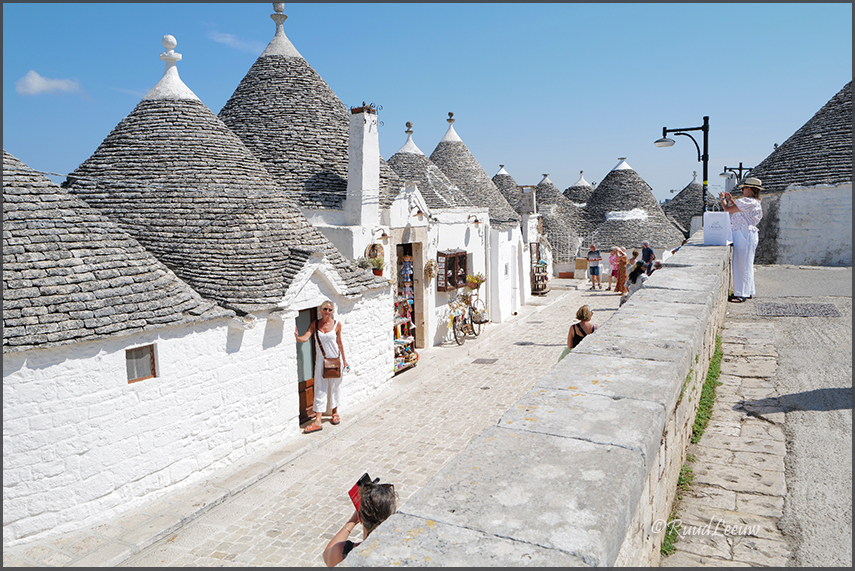
'A trullo (plural: trulli) is a traditional Apulian dry stone hut with a conical roof.
Their style of construction is specific to the Itria Valley, in the Murge area of the Italian region of Apulia. Trulli were generally constructed as temporary field shelters and storehouses or as permanent dwellings by small proprietors or agricultural labourers.
In the town of Alberobello, in the province of Bari, whole districts contain dense concentrations of trulli.
The golden age of trulli was the 19th century, especially its final decades, which were marked by the development of wine growing.' [¬ Wikipedia] |

'There are many theories behind the origin of the design. One of the more popular theories is that due to high taxation on property, the people of Apulia built dry stone wall constructions so that they could be dismantled quickly when tax inspectors were in the area.
In available historical records from the mid-14th century to the late 16th century, the area of Alberobello is referred to mostly as selva ("forest") and occasionally, as a land from which grazing animals were excluded. Evidence is lacking as to the existence of dwellings in the area prior to the seventeenth century.
In an 1897 photograph of the rione Monti (the district of the Mounts), the trulli are far less densely packed than today, being surrounded by enclosed gardens.' [¬ Wikipedia] |
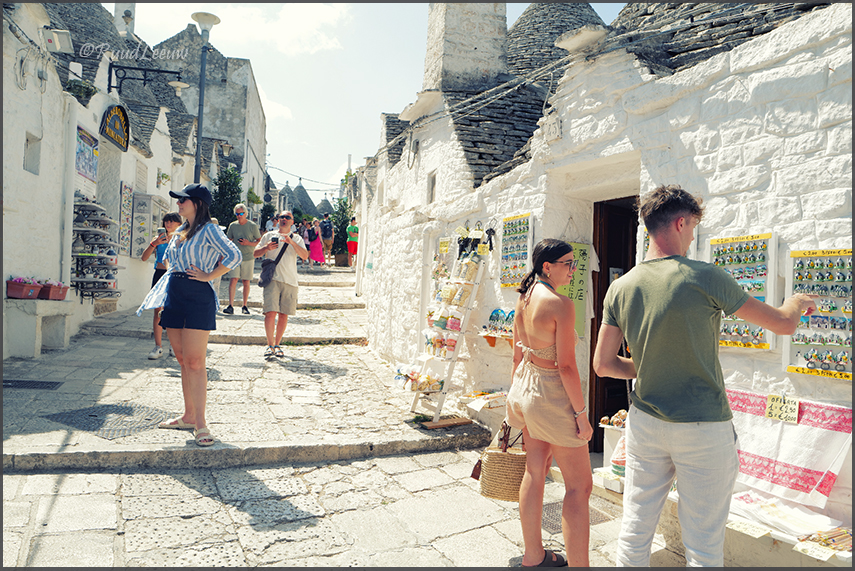
There is indeed a certain charm here, but restaurants were overrun by tourists and we left in a hurry.

This was actually the actual function of the trulli, sheds to store stuff.
|
MATERA
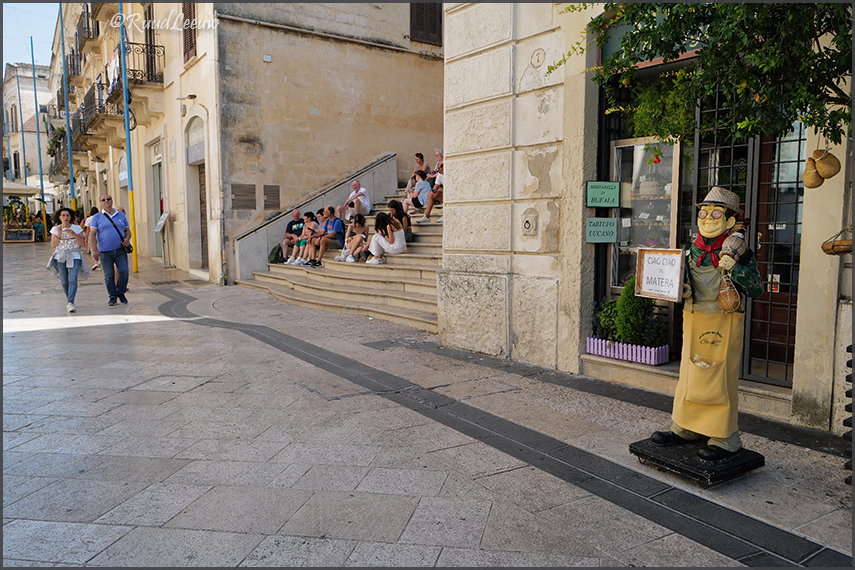
Matera wasn't the first place where we had to keep driving around to score a place to park our car, but here
we got lucky and found a spot near the start of the Zona Limitato (ZTL).
Allegedly, Matera is the 3rd oldest city in the world after Aleppo and Jericho!

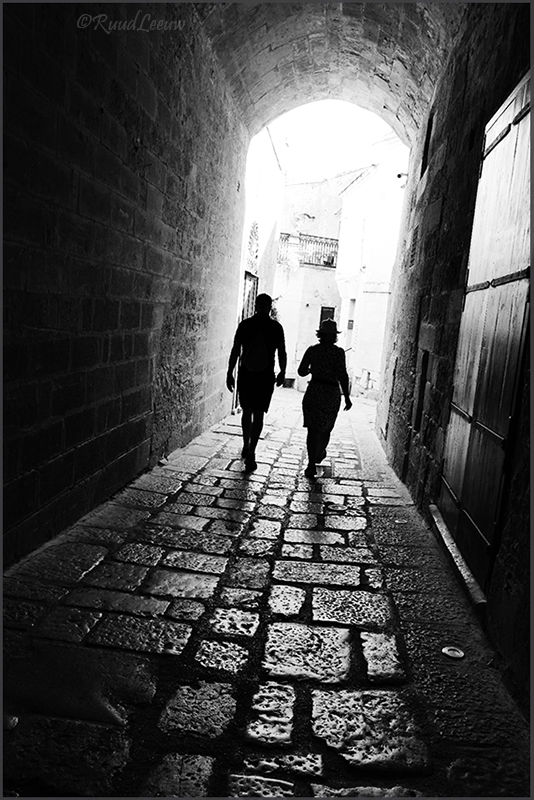
I made my way to the district with the caves, which was the
only thing we had time for in Matera.
Like Alberobello, it was overrun by tourists.
Matera is famous for its historic center, which is a UNESCO World Heritage Site.

In 2019 Italy's 9.000-year-old Matera was declared 'European Capital of Culture' for the entire year.
It was at this time I vowed to visit Matera if I could make it to this area. The time had come, however short.
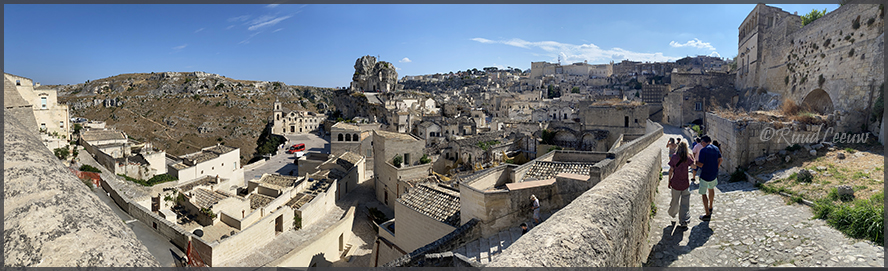
'Matera is a city in the region of Basilicata.
With a history of continuous occupation dating back to the Palaeolithic (10th millennium BC), it is renowned for its rock-cut urban core, whose twin cliffside zones are known collectively as the Sassi.
The city began as a complex of cave habitations excavated in the softer limestone on the gorge's western, Lucanian face.
The central high ground, or acropolis, supporting the city's cathedral and administrative buildings, came to be known as Civita, and the settlement districts scaling down and burrowing into the sheer rock faces as the Sassi.
The Sassi consist of around twelve levels spanning the height of 380 m, connected by a network of paths, stairways, and courtyards.
It was only at the turn of the 20th century that the Sassi were declared unfit for modern habitation, and the government relocation of all their inhabitants to new housing in the Piano followed between 1952 and the 1970s.' [¬ Wikipedia] |

That church ('acropolis') was too far for our time window to walk over to, and I found my trainers very slippery
here, so I made my way back to the center and regroup. We enjoyed crêpes and a cold drink before we headed
south for our hotel.
In 2024 I bought the book 'The Man, the Image & the World', a retrospective of Henri Cartier-Bresson and
found it includes several photos of Matera in 1951 (MyBlog 2024Q3)

|
MASSERIA SOVOIA

Only when we checked in we found they were preparing for a group of 30+ guests, so we could not enjoy the
swimming pool and the menu was cancelled, we had to eat what was prepared for the guests. Which was good.

The building was converted from a tobacco factory!
But again 'fine dining' here while a plate of spaghetti
would have been enough for me. The room was well away from the party and we were not disturbed by any noise.

My reading material this trip, Dictator by Robert Harris and The Hero's Way by Tim Parks,
'Walking with Garibaldi from Rome to Ravenna'. The books I read added to the success.

From Trentino to Puglia and up north again via Lazio and Umbria
|
METAPONTO
 Metaponto: archeological park of the urban area
Metaponto is a small town of about 1.000 people in the province of Matera, Basilicata, Italy.

Could be time for a new sign, but I think this site is run on a shoestring budget
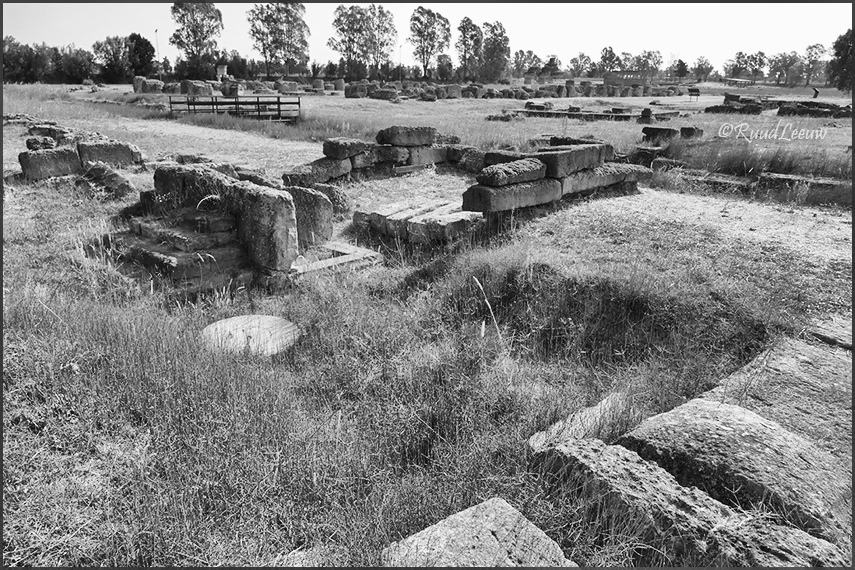
'The city of Metaponto was built by Greek settlers of Achaia in the second half of the 7th century to defend themselves from the continuous expansion of Taranto.
Metapontus allied himself with Sibari and Crotone, participated in the destruction of Siris, and aided Athens in the expedition to Sicily.
In 207 BC Metapontus offered hospitality to Hannibal, but the Romans punished her by destroying her, but in the first century before Christ returned to its maximum splendor, continuing its expansion until the Roman age.
Today, in Metaponto you can visit the Palatine Tables (not on this site, something to investigate on some future visit to this region) and the National Archaeological Museum.' (Note: the museum was closed during our visit, due to renovations). [¬ Wikipedia] |
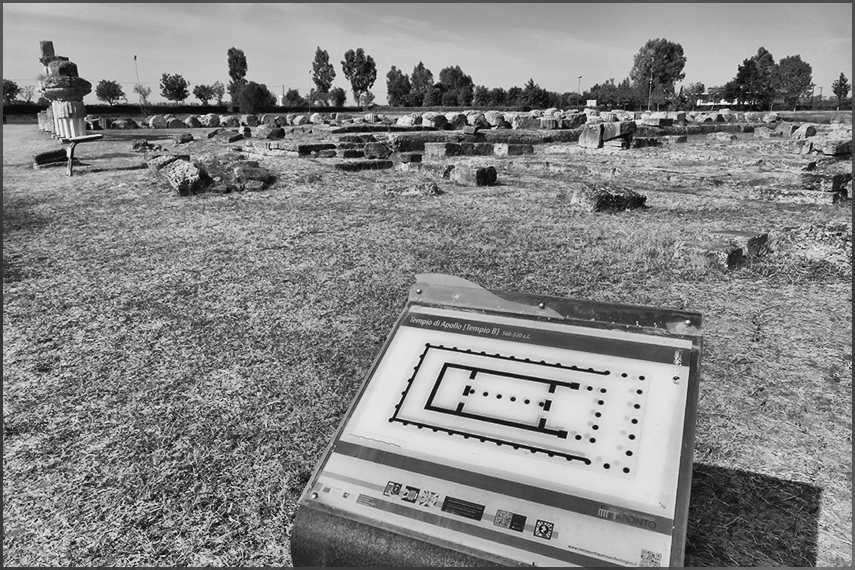
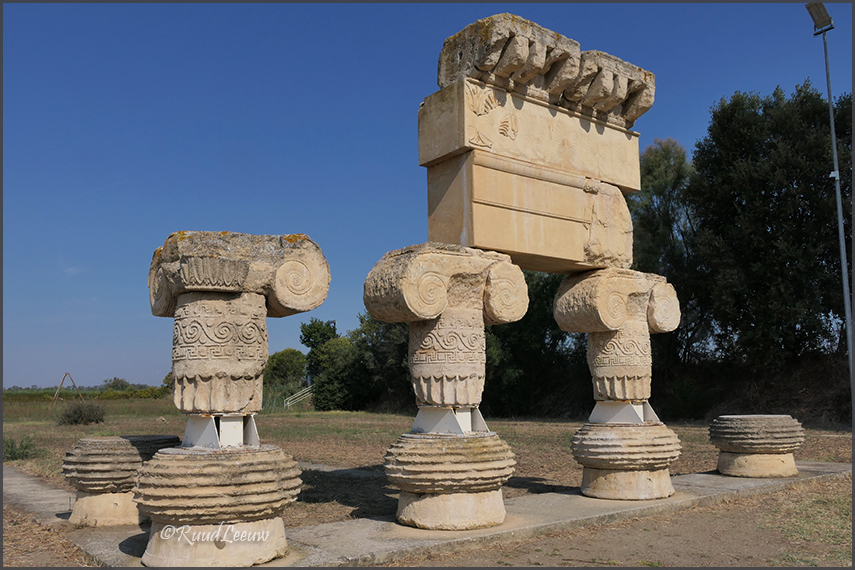
The ruins of Metapontum

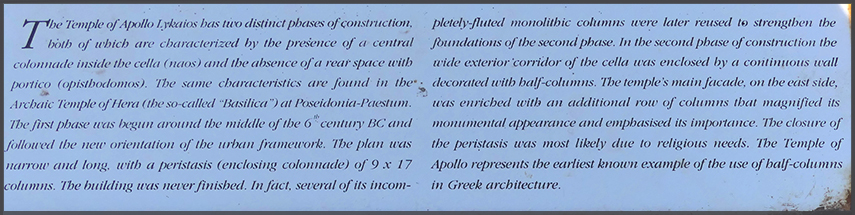
"The first phase was begun around the middle of
the 6th century BC.."
"The Temple of Apollo represents the earliest known example of the use of half-columns in Greek architecture."
|
PAESTUM
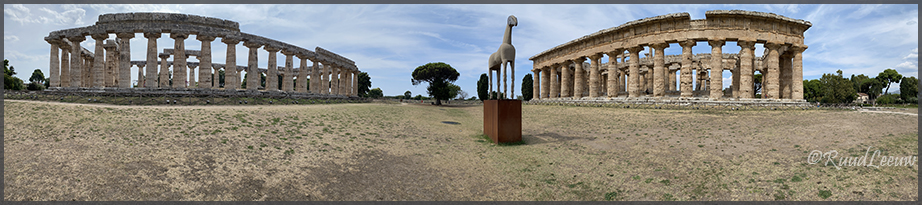

In spite of the midday temperature of 30 degrees Celsius, I forced myself to a thorough inspections of the ruins.
The city walls and amphitheatre are largely intact, and the bottom of the walls of many other structures
remain, as well as paved roads.

'Paestum was a major ancient Greek city on the coast of the Tyrrhenian Sea in Magna Graecia.
The ruins of Paestum are famous for their three ancient Greek temples in the Doric order dating from about 550 to 450 BC which are in an excellent state of preservation.
The whole ancient city of Paestum covered an area of approximately 120 hectares. Only the 25 hectares that contain the three main temples and the other main buildings have been excavated. The other 95 hectares remain on private land and have not been studied. The ancient city was surrounded by defensive walls, which are largely intact.'[¬ Wikipedia] |


Once called Poseidonia, the city was founded in the 7th century BC by Greeks colonists from Sybaris and it was probably occupied by a human settlement when they got there. During Greek occupation the city achieved
its greatest heights before to fall in Lucanians' hands (who changed the name to Paiston) and later under Rome control. It turned the name in Paestum once and for all when it was taken by Rome in 273 BC and continued to prosper until the mouth of river Salso started to be buried by sand and the whole place turned into a swamp.
When the swamp got bigger and bigger, the citizens left the place for good in the 9th century AD.
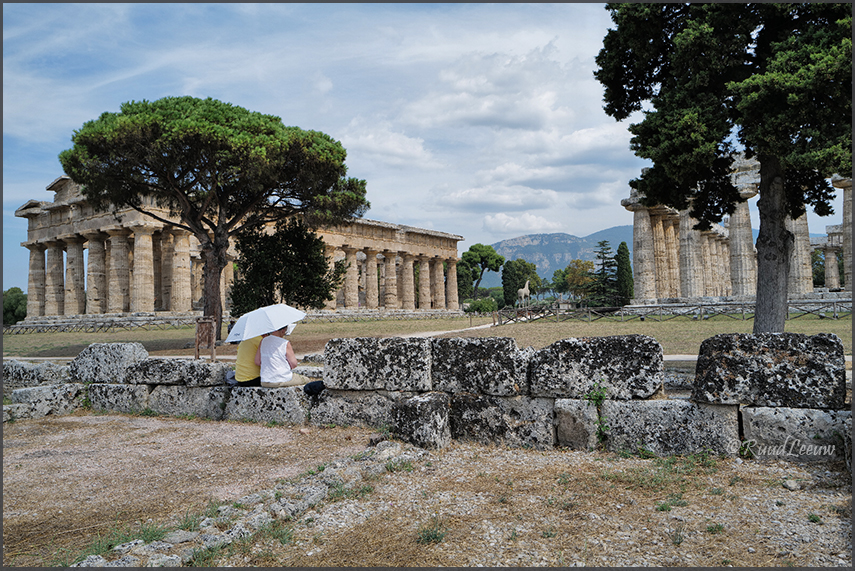
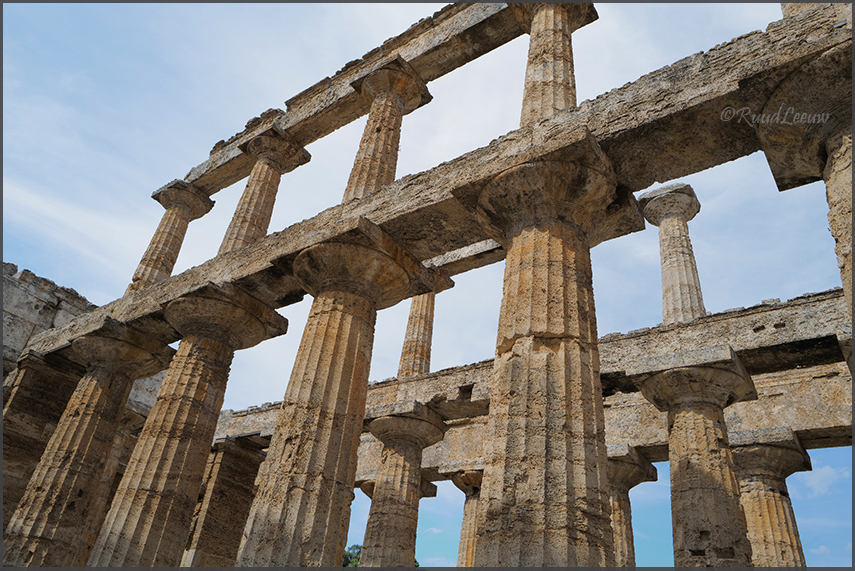


On 09Sep1943, Paestum was the location of the landing beaches of the U.S. 36th Infantry Division during the Allied invasion of Italy.
German forces resisted the landings from the outset, causing heavy fighting within and around the town.
Combat persisted around the town for 9 days before the Germans withdrew to the north.
The Allied forces set up their Red Cross first aid tents in, and around, the temples since the Temples were "off limits" to bombing by both sides... [¬ Wikipedia] |
|
Historical Museum of the Air Force of Vigna di Valle
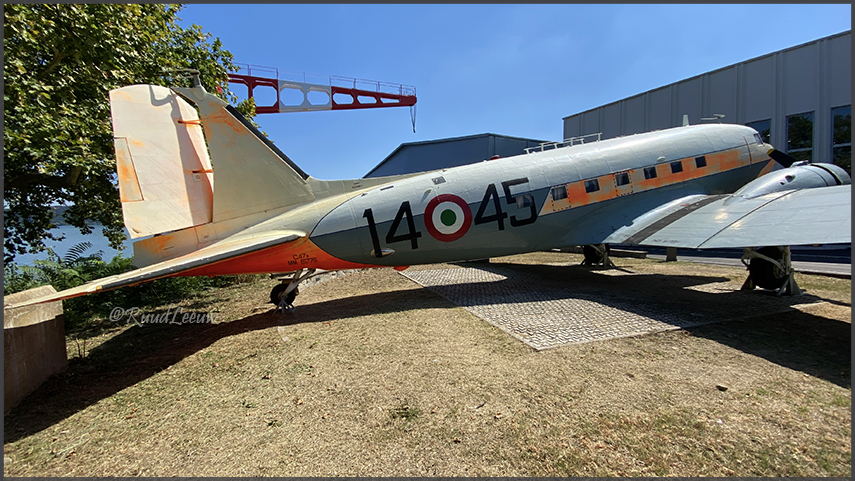
DC-3 at Vigna del Valle. See my REPORT of my visit here.
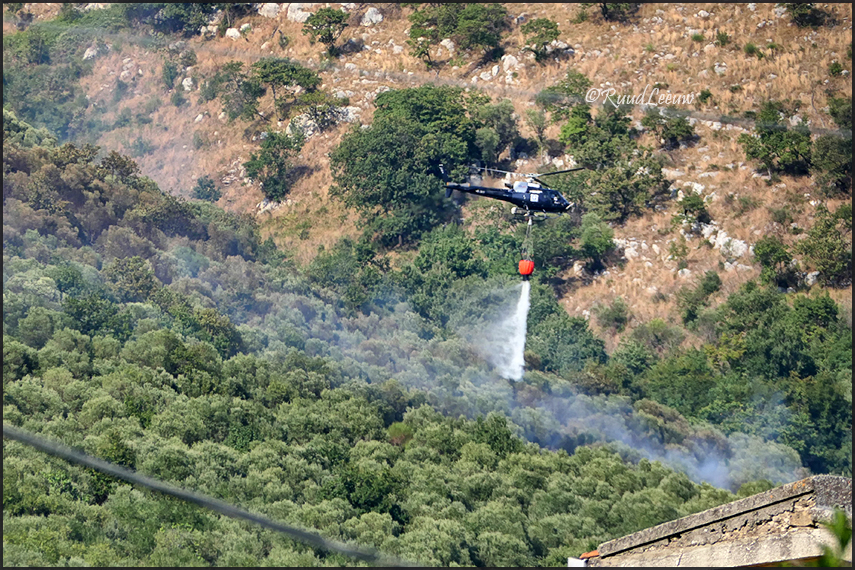
Aerial firefighting, east from Rome along SS7, the fire coming down from the mountain approaching the town!
The helo had registration SE-JXY, which makes it an Ecureuil H125 with c/n 8541 (manufactured 2018).
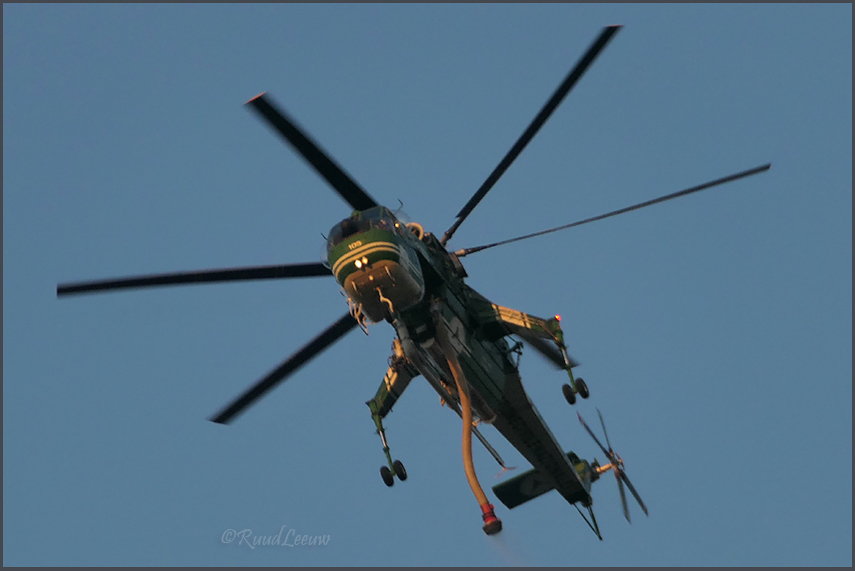
The first photo was taken on our way to our hotel Hotel La Campagnola Di Carbone Raffaela (Campizze), evidently heavier equipment was called in and through the window of our hotel room I shot the Sikorsky S-64 Skycrane
of the Vigili del Fuoco. Probably EFS 103 for I found a very similar EFS 102 on the internet.
|
LAGO DI BOLSENA

During this roadtrip through Italy we only stayed more than one night in Calliano, Venice and here in Bolsena.
| William Eggleston is quoted as having said: "I am afraid that there are more people than I can imagine who can go no further appreciating a picture that is a rectangle with an object in the middle of it, which they can identify. They don't care what is around the object aslong as nothing interferes with the object itself, right in the center." |

The only day we took a rest, not visiting any sights, one day of reading & resting. But the camera never sleeps..

Hotel Columbus sur Lago; definitely in the top three of stays during this trip!
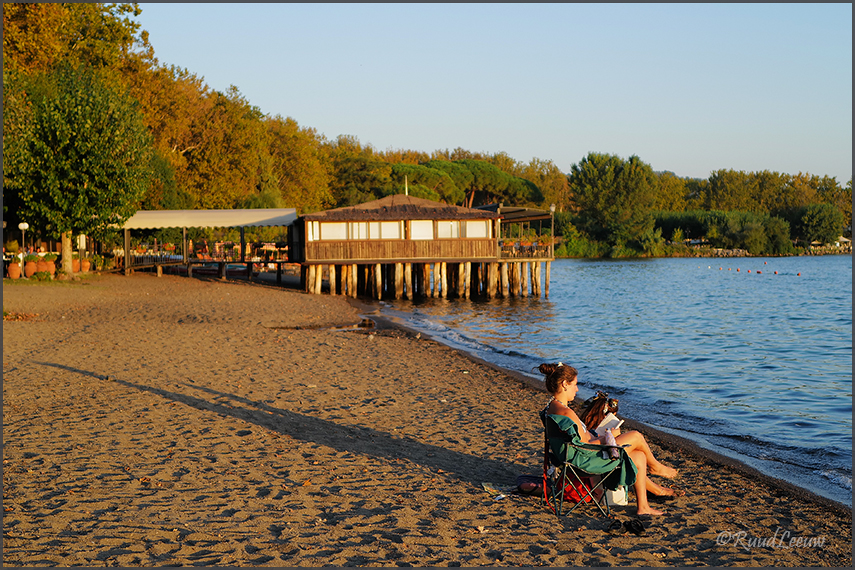
For my series #_OnReading
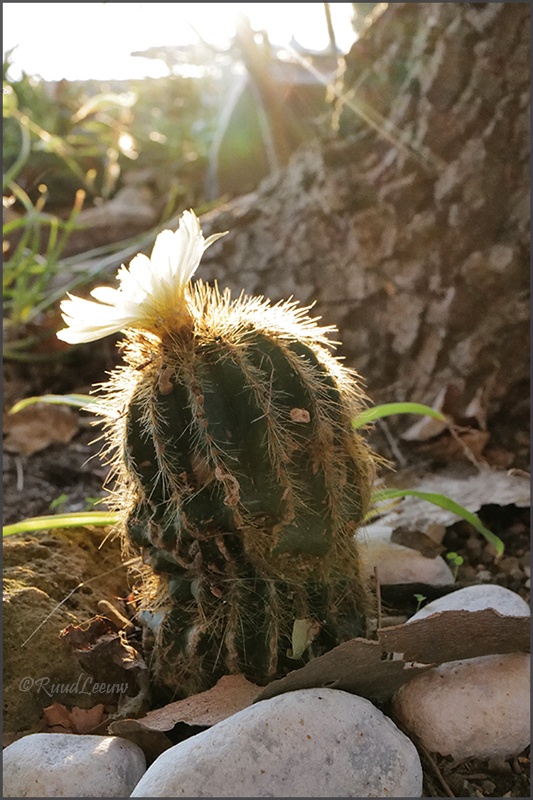


Everybody loves a lovely sunset!

When the guests are gone
|
ISEO
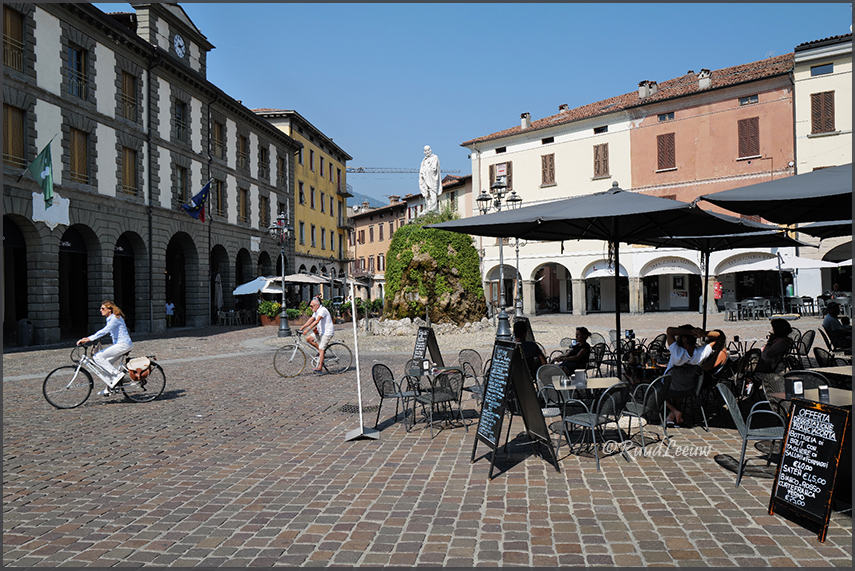
So many of my childhood holidays were spent here, I just had to make a tiny detour to say CIAO!
Thus ends this roadtrip which incorporated many places special to my parents (R.I.P.).

Iseo (Brescian: Izé) is a town and comune in the province of Brescia, in Lombardy, Italy, on the south shore of
Lake Iseo. It has the first monument ever built of Giuseppe Garibaldi, erected in 1883.
|
Arriverderci!
Created: 26Nov23 - Updated:
12 Februari, 2025
|

